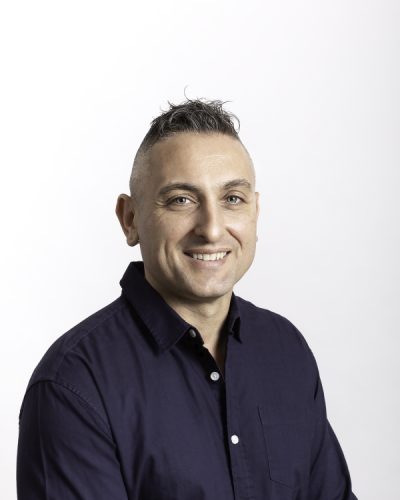
Anthony Lekkas
Please introduce yourself
I'm Anthony (he/him), a Greek man - I’m a relationship therapist, social worker and long-time bi+ community advocate based in Melbourne. I've worked for more than 20 years in the mental health and family violence sectors. I'm particularly passionate about creating spaces where people can explore their relationships, sexuality and identities without having to fit themselves into narrow boxes. I am also a dad of two boys and love watching them explore their own identities without the constraints I grew up with.
Please tell us a little about how you see yourself, in terms of being bi+ / multi-gender attracted?
I'm a cis bisexual man in a polyamorous relationship.
What would you like to share with us about your experience of being bi+?
For a long time, I thought I was the only one. Not because I didn't know the word ‘bisexual’ but because I rarely met anyone who openly identified that way, particularly cis men. Growing up, there didn't seem to be much room for anything other than being straight, maybe gay, but I didn’t know any queer people when I was a teenager.
Over time, I realised that being bi+ wasn't about being halfway between two identities. It was about having the capacity to experience attraction beyond a single gender and that it was a healthy sexuality. It became an important part of understanding myself, even though it wasn't always understood by others.
One of the biggest challenges has been invisibility. Depending on who I'm with, people often assume they know my sexuality. When I'm with my female partner, people assume I'm straight. When I'm with a man, they assume I'm gay. Those assumptions can quietly erase an important part of who I am and make me reluctant to say too much about myself.
As I've come to understand myself more deeply, I've also realised that the expansiveness of my attractions sits comfortably alongside the expansiveness of how I experience relationships. Identifying as both bi+ and polyamorous has felt deeply congruent for me. Both invite me to question inherited assumptions about what relationships are supposed to look like, who we are supposed to love and how love is ‘meant’ to be expressed.
I've learned that this can sometimes unsettle people. There can be an expectation to pick a side, to fit neatly into familiar categories or to organise our relationships in ways that make others feel comfortable. Living outside those expectations can be both liberating and, at times, lonely.
That's why community matters so much. Finding other bi+ people and people who embrace diverse ways of loving and relating has reminded me that there isn't one right way to build a meaningful life. Community offers more than friendship. It offers safety, understanding, affirmation and the reassurance that you don't have to shrink yourself to belong.
Today I'm fortunate to contribute to that community in several ways. Alongside my work as a mental health social worker and relationship therapist, I've helped found the Melbourne Bisexual Network, been involved with Bi+ Collective Australia and have enjoyed creating spaces where bi+ people can connect, share their stories and feel seen. I've come to believe that visibility isn't simply about being out. It's about helping create a world where people feel safe enough to discover, express and celebrate who they are.
If there's one thing I'd want another bi+ person to know, it's that you're not alone. There isn't a right way to be bi+. You don't have to prove your identity through your relationships, your history or who you're attracted to today.